Nutrition & Lactation
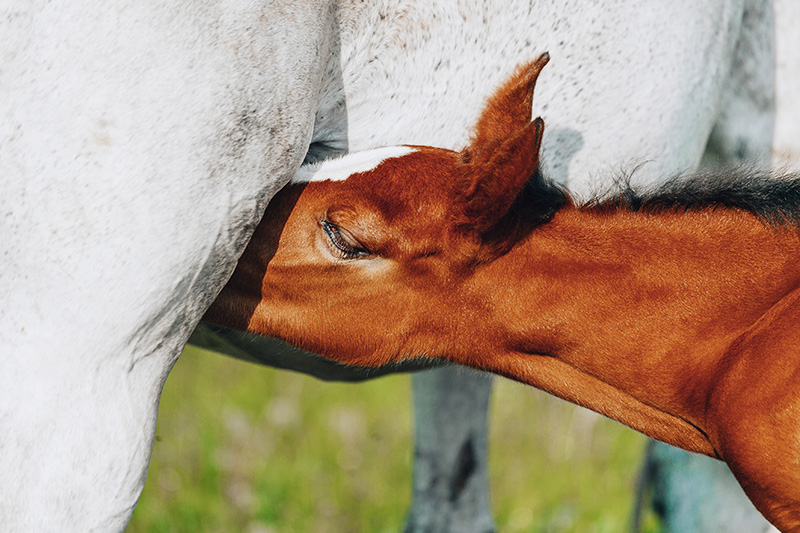
Did you know that in the first three months a mare produces as much as 3 to 4% of her body weight in milk? For a 600 kg horse, this is 18 to as much as 24 liters per day!
In the first three months, the foal receives all the nutrients from the mother through the milk. Of course, milk production demands an enormous amount from the mare and therefore she has a much higher need for energy and protein. A good and balanced ration keeps the mare healthy, in good condition and gives the foal a good start. Just what should a lactating mare's ration meet? In this blog, we write what the most important elements are and what a good ration should meet.
The last months of gestation
For the first seven months, the mare does not yet have an extra high need for nutrients. From the eighth month, the foal starts to grow considerably. The foal's weight for the seven months is only twenty percent of its birth weight. Hence, the nutritional requirements start to increase from the eighth month. The mare then has a higher need for energy and protein, as well as Vitamin A, E, Calcium, Phosphorus, and Copper. In addition, it is very important that the level of Selenium is up to standard.
Calcium and Phosphorus are important minerals for healthy bone growth in the foal and are desperately needed for milk production. Copper is needed for elasticity and composition of cartilage. Copper deficiency during gestation can affect the development of OCD and delay cartilage development. In addition, milk contains little copper, so it is important that copper levels are adequate during pregnancy. So that the foal already gets copper during pregnancy.
Research shows that increasing the amount of Vitamin E and Selenium in the mare's ration to twice the usual standard, results in colostrum with more immunoglobulins. Immunoglobulins are important for the foal's resistance. Vitamin E and Selenium deficiency can also cause white-muscle-disease and increase the risk of the afterbirth not coming off properly.
 From gestation to milk production
In the final weeks before the foal approaches birth it is best to feed the mare a little less coarse-stemmed roughage. With the growth of the foal, there is less room for a full colon. It is better to choose a soft, good quality roughage then. That contains a higher content of energy and protein. After delivery, the mare mainly needs water. To stimulate the mare's intestinal function, you can make a slobber with flaxseed, bran and electrolytes.
In the first three months, milk production rises to its maximum and then gradually decreases. Therefore, she has a much higher need for energy and protein during these months. Good quality forage rich in energy and protein is important. The fresh, young spring grass contains a lot of energy and protein and is an excellent source of nutrition for mares with foals. If the grass or forage does not contain enough protein, then supplementation is important! The feed ration need not be maximum immediately after foaling, so build up the feed ration. Rapid feed changes are detrimental to the intestinal health of the horse. This is because a horse's gut flora is specific to what food the horse eats. It may take 2 to 3 weeks for the intestinal flora to adjust to a new ration. It is wise to gradually switch the mare from roughage to grass.
Of course, vitamins, minerals and trace elements are also important for the health of the mare and the development of the foal. The need for Calcium and Phosphorus increases considerably, it is as much as 3 times higher in the lactation period. The absorption of minerals and trace elements are not fully guaranteed with only grass or roughage. You can supplement the ration with a special mare pellet. This pellet contains more nutrients specifically for the mare, than an ordinary sport pellet. Also build up the concentrate gradually. You can also opt for a vitamin-mineral balancer and/or supplement.
"Did you know that a mare produces as much as 3 to 4% of her body weight in milk in the first three months?"
Supplementation with HorseAdds
HorseAdds offers several products to support your pregnant or lactating mare. Many mare diets do not contain enough Calcium and Phosphorus to meet the mare's needs, especially in the first three months. HorseAdds Lacto can be used as a supplementary feed to easily add extra Calcium and Phosphorus to your mare's ration.
Is your mare losing too much of her body condition? If so, she needs extra energy and protein. HorseAdds Proti+ is a good protein supplement, containing as much as 44% crude protein! HorseAdds Powerlin is also suitable, consisting of extruded linseed and rapeseed meal. Powerlin also contains a high proportion of high-quality amino acids and has a high fat percentage! Ideal for adding both extra protein and energy to the ration.
Want to feed little kibble but still provide a balanced ration? Then you can also feed our HorseAdds Balance in an appropriate quantity. For a 600 kg horse, we recommend feeding 240 grams of HorseAdds Balance supplemented with 0.6 kg - 1.2 kg of HorseAdds Lacto.
Not quite figuring out what's best for your mare? Fill out our Request Nutrition Advice and Custom Made and send it to info@horseadds.com. We can help you create a balanced ration.