Forage | Forage Analysis
The absolute basis of a good ration for your horse; last summer's roughage, has had all the time it needs to die off by now and your horse has probably been eating it for a while. Perhaps you are as curious as we were, because how is the quality this year? Maybe you have even had it analyzed, but don't know exactly what all the values mean. We want to tell you a little bit more about this; what kind of analyses there are and how to interpret all the values on a comprehensive analysis - we are going to tell you in the coming blogs.
Because we have annual averages of different types of forage through Eurofins Agro (the largest laboratory for forage analysis in the Netherlands), we can also tell you how this year's cuts compare to those of past years.
Forage is the basis of a good ration
Good nutrition is important for the health and performance of the horse. The basis for a good ration consists primarily of good quality roughage. Roughage is important for proper intestinal function and provides a sense of satiety. Roughage is the main source of energy for the horse and includes proteins, fats, sugar, minerals and trace elements. Roughage in the form of hay or long-stemmed haylage is best for most horses.
"Did you know that a horse eats about 2-2.5% of its body weight in dry matter per day? This can even increase to 3% when an ample amount of grass is available, in ponies it can even increase to 5%!"
What is a forage analysis?
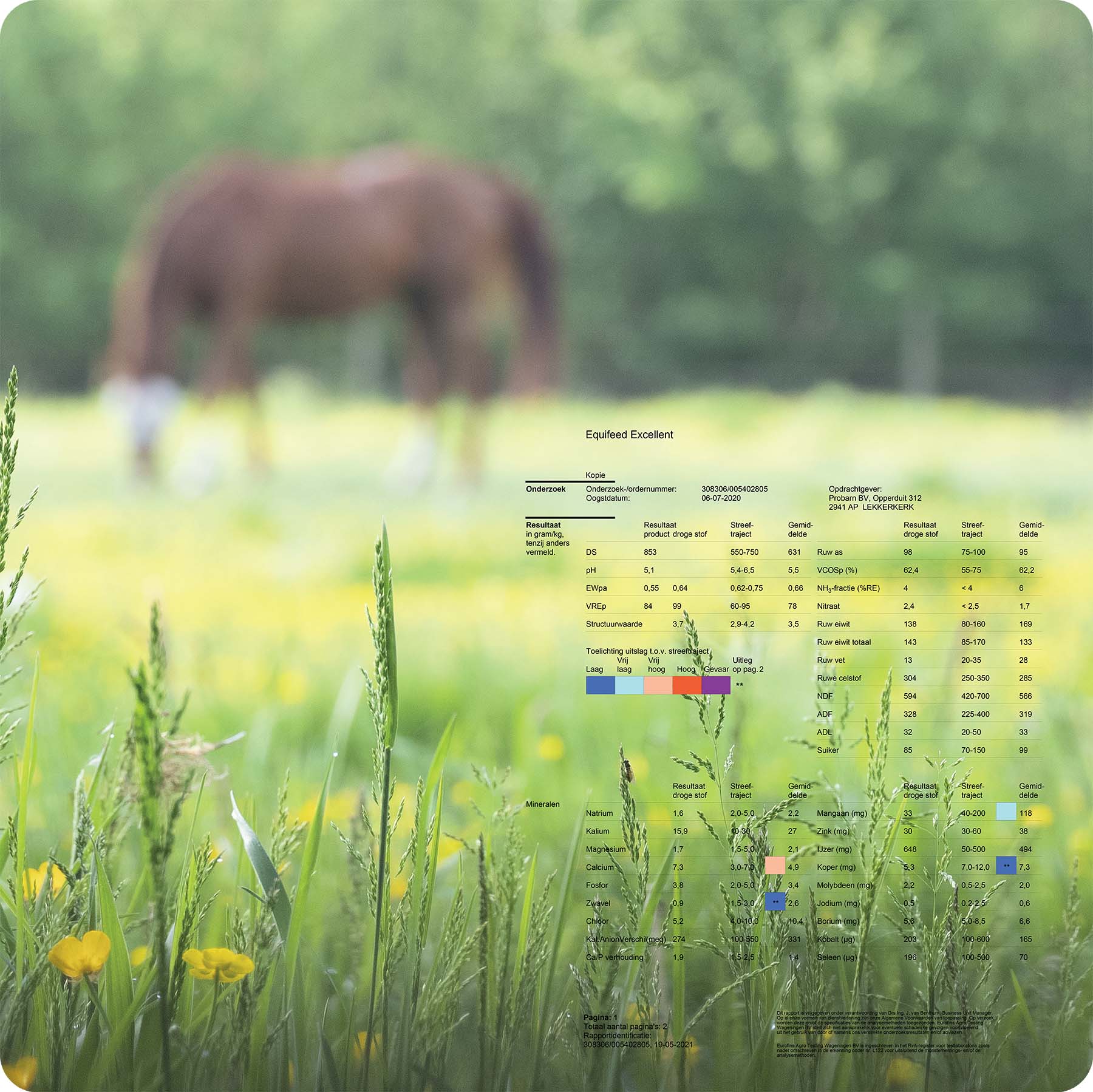
A forage analysis consists, depending on which analysis you choose, of the analytical constituents, minerals and trace elements. By now quite well-known is the Pavo Quickscan, on which you find the dry matter content of the forage and an indication of Energy Value, Crude Protein and Sugar. The figures fall within a target and are therefore not definitive. Eurofins itself offers the Equifeed Basis and the Equifeed Excellent. The Basis contains all analytical constituents, with the Excellent this is expanded to include minerals and trace elements. In this blog we will explain the most comprehensive forage analysis and the main differences between this year and previous years.
Analytical constituents
The first section on a forage analysis shows the analytical constituents. Of some you will know exactly what it means, but below we will explain them all.
Dry Dust
In alle voedermiddelen zit een hoeveelheid water. De rest wordt droge stof (DS) genoemd. Voor een goede beoordeling van de waarde en onderlinge vergelijking tussen voeders is het belangrijk om het DS gehalte te kennen of in te kunnen schatten. Zo bevat gras ongeveer 18% droge stof, voordroog 65%-75% en onverpakt hooi ongeveer 85% (DS gehaltes <80% kunnen bij onverpakt hooi zorgen voor broei).
The maximum DS intake, depending on the horse's weight, condition and performance, is about 2.5% of body weight from both roughage and concentrates. This means that a 600 kg horse can eat about 15 kg of dry matter in 24 hours. If the horse eats only roughage, the maximum is about 2%. If the horse has access to an ample amount of grass, then the intake can increase to 3% and, especially in ponies, this can sometimes be even higher, even up to 5%! For healthy intestinal flora, it is important that the horse takes in at least 1%, but preferably 1.5% DS roughage per kg body weight per day. Thus, a horse of about 600 kg should take in about 9 kg dry matter of roughage per day.
Crude ash
Crude ash is the inorganic portion of organic matter. It is the proportion that remains after combustion. This content is on average between 75 and 100. If it is much higher, it often means that a lot of soil fraction has been analyzed (as soil does not burn) and this can mean that the roughage is very dusty. This also increases the likelihood of butyric acid, which has a negative effect on intestinal flora.
VCOS (%)
The VCOS (%) stands for organic matter digestion coefficient, which is represented as a percentage. It indicates the extent to which the organic matter, including protein, fat and sugar, can be digested by the horse and converted in the body. On average, this content is around 60%. Often this content is lower in coarse-stemmed roughage. Coarse-stemmed roughage consists of many plant stems and these contain a lot of fiber. Also difficult to digest fiber, under crude fiber we tell more about the different types of fiber.
NH3 fraction (%RE)
The NH3 fraction means ammonia fraction, this is a measure of how well the forage is preserved. It represents the difference between crude protein total and crude protein. During preservation of packaged forage, protein is broken down. When a lot of protein is broken down, ammonia, a waste product, is produced. A high NH3 percentage indicates that preservation was poor and a lot of protein was lost.
Nitrate
Nitrate is a chemical compound and shows how fertilization has been of the land. A high nitrate level means improper fertilization, or fertilization was too short before mowing. It gives a foul odor and taste to the forage. Very high nitrate levels are not beneficial to health and can even be deadly.
Crude protein
Crude protein indicates the amount of protein in the forage. Protein consists of amino acids, distinguishing between essential and non-essential amino acids. Essential amino acids include Lysine, Threonine and Methionine. These high-quality amino acids are important for building muscle. Methionine is a sulfur-containing amino acid, and sulfur is also important for healthy skin and strong hooves. If the protein content in the roughage is low, this not only affects muscle building but also, therefore, the coat condition. Excess protein is stored in the body and therefore your horse can easily become overweight.
Crude fat
Crude fat indicates the amount of fat in the roughage, fat is a source of energy for the horse and good for the skin and coat. Omega-3 fatty acids in particular are good for coat and skin condition. By nature, a horse is a grazer and fresh grass is particularly rich in omega-3 fatty acids. Only, because omega-3 fatty acids are very sensitive to oxidation, they are largely lost during the drying process of grass (to hay). This means that hay or haylage is actually richer in relation to omega-6 fatty acids. Supplementation of omega-3 is therefore definitely recommended in winter. With a low crude fat content in roughage, you often see a dull, flaky coat and your horse's energy level may be a bit on the low side.
Crude fiber
Crude cellular matter represents the proportion of cell walls, also called fibers. A plant cell consists of cell content and a cell wall. The cell content contains the nutritional value (protein, fat, sugar). A cell wall consists of fibers: cellulose, hemicellulose, pectin and lignin. Pectin is easily digested by the horse, cellulose and hemicellulose less so, and lignin is not digestible at all. The cell wall gives structure and strength to the plant. The higher the crude fiber content, the more fiber and structure the forage contains. The proportion of fiber in roughage is further divided into the following components:
- NDF = NDF stands for Neutral Detergent Fibre, it represents total cell walls, or fibers such as cellulose, hemicellulose and lignin. This can be used to determine the ratio of cell walls to cell content.
- ADF = ADF stands for Acid Detergent Fibre and consists mainly of difficult to digest fibers such as cellulose and lignin.
- ADL = Acid Detergent Lignin. Lignin is also called wood dust and is not digestible by horses. The more lignin, the less digestible the forage is.
EWpa and VREp
The EWpa, Energy Value Horse, gives an indication of how energy-rich the forage is for the horse. The VREp, Digestible crude protein horse, gives an indication of how protein-rich the roughage is for the horse. These two values depend on the digestion coefficient, crude protein, crude fat and crude fiber. If the digestion coefficient is low, as a result the EWpa and VREp are also low. If the crude protein is low, the VREp is also low, and if the crude fat is low, the EWpa is consequently also low. The crude fiber, is this high, the digestion coefficient is low and so automatically the EWpa and VREp as well.
Structure Value
Texture value indicates how fiber-rich the forage is. The higher the structure value, the higher the crude fiber and this therefore means more fiber in the roughage. You can often see this yourself. What you again cannot see is the distribution of hemicellulose, cellulose and lignin and thus the ratio of NDF and ADF/ADL. Structure is important for horses, but too much ADF/ADL, reduces the utilization of nutrients from the hay extremely and gives a higher risk of constipation colic.

Minerals and trace elements
The second part of the Equifeed Excellent analysis contains the minerals and traces. We will cover these in detail in upcoming blogs.
What are the main differences from previous years?
This year mowing has often been later than normal, due in part to weather conditions. The grass has had longer to grow on, resulting in more structure and fiber. As a result, the crude fiber (NDF, ADF, ADL) and structure value is higher this year than previous years.
Sufficient fiber is very important for horses to maintain healthy intestinal flora. However, it is important that there is sufficient digestible fiber in the forage. Grass that has overshot in growth contains many plant stems and these often contain too much lignin (wood dust) and cannot be digested by horses. The forage then becomes too "woody," and this can be easily felt on the stalks. As a result, horses can't extract many important nutrients from the forage and overall digestion can become slightly disturbed. We are therefore seeing many more horses this year with persistent manure water or inconsistent manure.
"Coarse-stemmed roughage with many plant stems, often contains a lot of indigestible fiber. This results in the horse not being able to get enough important nutrients from the roughage and digestion becomes impaired."
Roughage supplements
You can supplement roughage in many ways. If you want to add more digestible fiber to your ration, soy hulls are a good supplement. These consist of the highly digestible fiber Pectin and are also called super fibers. They support good digestion and healthy intestinal flora.
Psyllium can also help with proper digestion because of its high fiber content. This improves intestinal flora, but psyllium also provides a protective layer to the intestinal wall. This may allow it to recover more easily.
You can supplement the fat content of roughage with vegetable oils. Flaxseed oil is then the most suitable because it is rich in Omega-3 fatty acids. Especially in the winter season, these fatty acids are important to supplement. Roughage has lost most of its omega-3 due to oxidation and concentrates consisting of grains are anyway rich in omega-6 and poor in omega-3 fatty acids.