Forage || Minerals
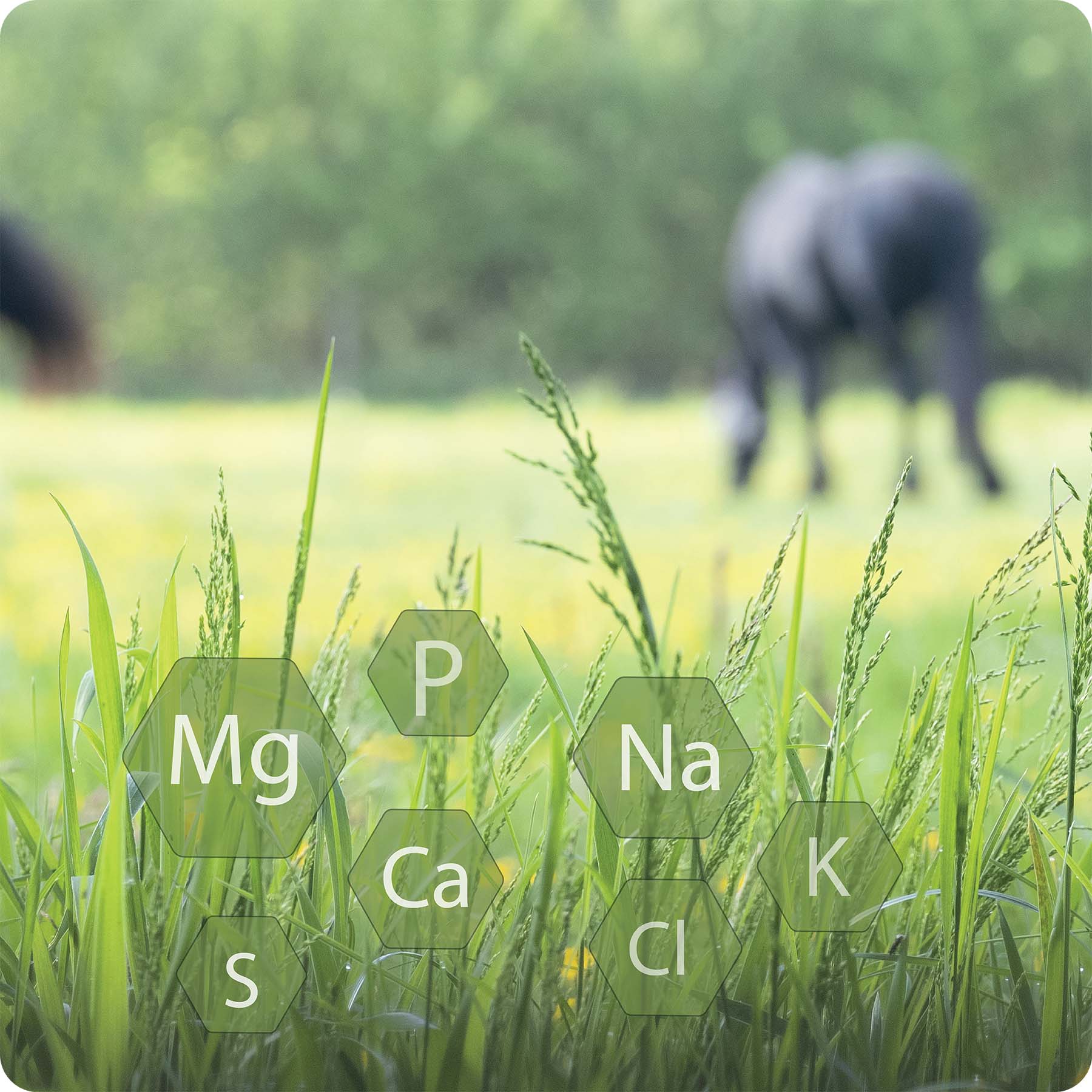
On a comprehensive forage analysis, minerals are analyzed, what are the requirements standards and what functions do these seven elements have? In this blog we go into this in detail. The following minerals can be found on a forage analysis:
-
- Sodium
- Potassium
- Magnesium
- Calcium
- Phosphorus
- Sulfur
- Chlorine
Sodium, Chloride, Potassium, Magnesium and Calcium are also related to each other as the electrolytes group. When sweating, these electrolytes are excreted and then must be replenished.
Sodium chloride
Sodium and chloride together are important for fluid balance in the body, recovery of muscles after exercise, kidney function and transmission of nerve and muscle impulses. In addition, chloride is a vital component of bile and important in the production of stomach acid and thus for proper digestion. If the body becomes too "acidic" (has too low a pH), then nutrients are not absorbed as well and thus, for example, recovery after exercise will take longer than normal.
When sweating a lot, these electrolytes are excreted. When a horse is deficient in "salt," it can be seen by licking or chewing at the fence, stones or ground. With prolonged deficiency, the horse develops health problems. The appetite decreases, the horse develops a dull coat, and with a severe deficiency, the horse may even be lethargic and exhausted. Because sodium chloride has the function of transmitting nerve and muscle impulses, when deficient the horse may have difficulty controlling its muscles. Sodium chloride is very easy to supplement by hanging a lick in the stable. This allows the horse to absorb its salt requirements when it needs it itself.
An excess does not actually occur; with sufficient fresh water, excess salt is excreted with the urine. However, in horses with a known kidney problem, too much salt is of course harmful. In this case, the veterinarian should be contacted.
Sodium requirement for maintenance of the horse is 2.6 grams per day per 100 kg of body weight and chloride requirement is 10.4 grams per day per 100 kg of body weight. The more the horse exercises and sweats, the higher the salt requirement.
Calcium, Magnesium & Phosphorus
About 99% of the body's calcium is found in the bones and teeth. The skeleton can serve as an accessible storage site for calcium. Most storage of magnesium (60-70%) is also found in bones, about 30% is found in muscles. Phosphorus is also an important component of bones, as bones consist of 14% phosphorus. So all three are important for skeletal strength, healthy bones and bone growth. In addition, of course, they each have their own function.
Calcium
Calcium is needed for muscle tightening, or muscle contraction. In the horse, magnesium plays a role in muscle relaxation. Together, they are essential for proper muscle function. Calcium is absorbed in the small intestine with the help of parathyroid hormones and vitamin D. Horses can demobilize calcium from bones; a mare in lactation can thus take up some of her calcium reserves for milk.
Calcium deficiency can result from an acute increase in requirement or when an inadequate level is fed for an extended period of time (chronic deficiency). When calcium is deficient, the following abnormalities can occur: lameness, skeletal deformities, osteoporosis (osteoporosis), bone fractures and nervous system problems. With excess calcium, muscle weakness and brittle bones can occur.
For horses, an absorption efficiency from feed of 50% is used. For young horses this can be as high as 70%, but this decreases as the horse ages. Calcium absorption depends on many factors, so specific absorption rates are difficult to determine.
The daily requirement for calcium is 5.2 grams per day per 100 kg of body weight. In lactation, the horse has a higher requirement of calcium for milk production.
Magnesium
Magnesium has multiple functions in the body, besides maintaining healthy bones and relaxing muscles, magnesium also plays a role in stimulus conduction of nerves and energy supply in the body. Magnesium has a positive effect on tension. When the horse is stress sensitive, Magnesium can support the horse to relax better.
Magnesium deficiency can manifest itself in various symptoms; horses may have a poor appetite, show tense behavior, sweat a lot, but will especially suffer from muscle cramping. Muscle tissue function deteriorates because Magnesium is important for proper muscle function. Magnesium deficiency can also affect bone strength.
The average absorption of Magnesium from food is 49.5% (40-60%). The total absorption of Calcium and Magnesium in roughage is one and a half to three times greater than in concentrates. This is partly due to the time the two feeds spend in the stomach and where they are digested. The different forms of magnesium (magnesium oxide, magnesium citrate and magnesium chelate) also have their own bioavailability. This is due to the oxidation of the compounds in the stomach. Because magnesium chelate (a compound as an amino acid) is the compound least susceptible to oxidation, it is best absorbed. The daily requirement for magnesium is 1.85 grams per 100 kg of body weight. This requirement increases during lactation and with exercise and sweating.
"Calcium and Magnesium absorption from feed is between 40-60%, lower for older horses"
Phosphorus
In addition to being essential for bone growth, phosphorus also plays an important role as a component of adenosine di- and triphosphate (ADP and ATP). These serve as a source of energy for all cells and body processes. In addition, phosphorus is involved in DNA production and as a component of cell membranes.
A phosphorus deficiency causes symptoms such as muscle weakness and muscle tremors. In addition, phosphorus deficiency can interfere with the horse's ability to regulate energy requirements and leads to high blood levels of glucose and fats. Deficiency of calcium, phosphorus and magnesium can lead to improper bone formation in young horses.
The daily requirement is 3.7 grams per 100 kg of body weight and increases during lactation and according to exercise. Foals have less calcium in their bones, which is why high levels of calcium and phosphorus in the feed are needed in foals.
Relationships and interactions
Excess calcium, in proportion to phosphorus and magnesium, interferes with the process of bone formation. The ideal calcium- phosphorus ratio is 2:1, for young horses it is 1.5:1. The ideal Calcium- magnesium ratio is 2-3:1
Because of the chemical similarity between Calcium and Magnesium, both ions use the same absorption and transport mechanisms in the body. A ration high in Calcium (also phosphorus) lowers the utilization of Magnesium from the feed. An excess of Calcium in the diet therefore causes a deficiency of Magnesium. Especially in foals, extra attention must be paid to the magnesium supply in connection with bone formation.
"The ideal calcium-phosphorus ratio is 2:1, for young horses it is 1.5:1"
Potassium
Potassium regulates water absorption by organs, bones and muscles. Together with sodium, potassium forms the sodium-potassium pump, it keeps the fluid inside and outside the cells in relation to each other (osmotic pressure). It is an essential nutrient for growth and muscle formation. Potassium also influences the conduction of nerve impulses and muscle contraction. Potassium is involved in the maintenance of acid-base balance. Potassium affects performance, appetite and fertility.
Deficiency or excess rarely occurs. Deficiency may cause decreased appetite, decreased growth, muscle wasting, joint stiffness, fatigue and general weakness. An excess is excreted through urine/ stool/sweat.
The daily requirement is 6.5 grams per 100 kg of body weight.
Sulfur
The sulfur-containing amino acids cysteine and methionine are part of the structure of almost all proteins and enzymes in the body. Horses meet their sulfur requirements primarily through the intake of cysteine and methionine.
Sulfur is important for the entire body, but sulfur is essential for a number of body processes. High concentrations are found in the skin, hair, hooves, bones and joints, among others. For example, sulfur is needed for the production of keratin, a protein found primarily in hair and hooves. In addition, sulfur helps in the production of collagen. Collagen is an important component of connective tissue in the skin and provides elasticity to the tissue. Sufficient sulfur helps your horse keep the skin supple, supports coat condition and strengthens the hooves. Sulfur is also important for cartilage and tendons because they consist largely of collagen. In addition, sulfur plays an important role in reducing allergy symptoms. Excessive sulfur intake negatively affects selenium and copper supply.

Forage analysis is the only way to understand the contents
What are the main differences from previous years?
It is notable that the levels of a number of minerals and trace amounts have decreased in recent years. Thus, we see that the Sodium, Magnesium, Calcium, Sulfur, Zinc and Selenium levels, among others, are lower than previous years. For example, Magnesium content decreased from 2.1 g/kg ds to 1.7 g/kg ds and Calcium from 5.2 g/kg to 4 g/kg ds. The average sulfur content decreased from 2.4 g/kg ds to 1.9 g/kg ds. We receive the average values annually from Eurofins Agro, our choice of partner in forage analysis.
It is not possible to say with certainty what the cause is behind this reduction. However, fertilization rules have been tightened considerably in recent years, the total phosphorus in cattle feed has been lowered considerably, and in addition it has been very dry for a long time in 2019 and 2020. When forage is obtained from plots where horses are also grazed, you also see effects of this grazing on the soil structure and thus the quality of the soil. On parcels where horses walk, the soil density is often higher, which results in less air in the soil and lower organic matter. In addition, horse manure is acidifying to the soil, leading to a lower pH. These two issues result in the soil being more susceptible to leaching of nutrients, including minerals and trace elements.
"We see that a number of minerals have declined in recent years, including Sodium, Magnesium, Calcium and Sulfur"
HorseAdds supplements to supplement
With concentrates or supplements, deficiencies from roughage can easily be supplemented. HorseAdds offers a variety of supplements to target ration deficiencies, which we call our Single Ingredient Supplements (SIS). Of course, you can also choose a completely balanced balancer such as our HorseAdds Balance.