
Description
Calcium and Phosphorus for Horses
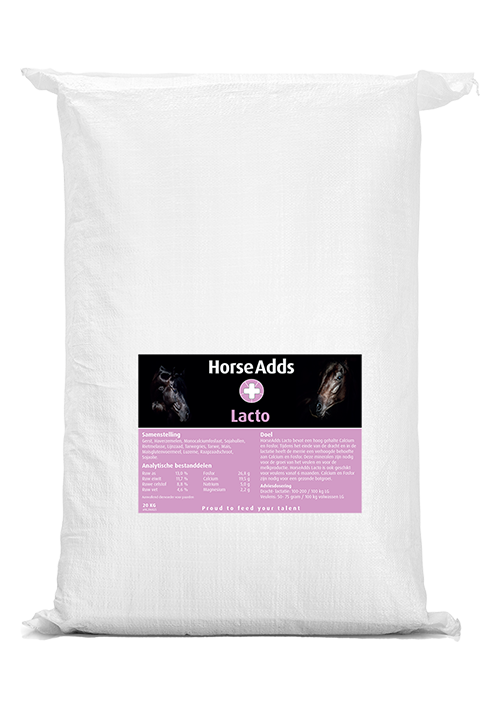
Horse Adds Lacto contains Calcium and Phosphorus for horses. About 99% of the body's calcium is found in the bones and teeth. The skeleton can serve as an accessible storage site for calcium. Phosphorus is also an important component of bones, as bones consist of 14% phosphorus. So both are important for skeletal strength, healthy bones and bone growth. In addition, of course, each has its own function.
Calcium for horses
Calcium is needed for muscle tightening, or muscle contraction. In the horse, magnesium plays a role in muscle relaxation. Together, they are essential for proper muscle function. Calcium is absorbed in the small intestine with the help of parathyroid hormones and vitamin D. Horses can demobilize calcium from bones; a mare in lactation can thus take up some of her calcium reserves for milk.
A calcium deficiency in your horse can result from an acute increase in requirement or when an insufficient amount is fed for an extended period of time (chronic deficiency). With calcium deficiency, the following abnormalities can occur: lameness, skeletal deformities, osteoporosis (osteoporosis), bone fractures and nervous system problems. With excess calcium, muscle weakness and brittle bones can occur.
For horses, an absorption efficiency from feed of 50% is used. For young horses this can be as high as 70%, but this decreases as the horse ages. Calcium absorption depends on many factors, so specific absorption rates are difficult to determine.
Phosphorus for horses
In addition to being essential for bone growth, phosphorus also plays an important role as a component of adenosine di- and triphosphate (ADP and ATP). These serve as a source of energy for all cells and body processes. In addition, phosphorus is involved in DNA production and as a component of cell membranes.
A phosphorus deficiency in your horse produces symptoms such as muscle weakness and muscle tremors. In addition, a phosphorus deficiency can interfere with the horse's ability to regulate energy needs and leads to high blood levels of glucose and fats. Deficiency of calcium, phosphorus and magnesium can lead to improper bone formation in young horses.
Foals have less calcium in their bones, which is why high levels of calcium and phosphorus are needed in foals' feed.
Calcium Phosphorus ratio
Excess calcium, in proportion to phosphorus and magnesium, interferes with the process of bone formation. The ideal calcium- phosphorus ratio is 2:1, for young horses it is 1.5:1. The ideal Calcium- magnesium ratio is 2-3:1
Because of the chemical similarity between Calcium and Magnesium, both ions use the same absorption and transport mechanisms in the body. A ration high in Calcium (also phosphorus) lowers the utilization of Magnesium from the feed. An excess of Calcium in the diet therefore causes a deficiency of Magnesium. Especially in foals, extra attention must be paid to the magnesium supply in connection with bone formation.
Advisory dosage
Foals and growing horses 50-75 grams per 100kg adult body weight.
During gestation or lactation 100-200 grams per 100kg body weight.
During gestation or lactation it is advisable to feed Horse Adds Balance in addition to Horse Adds Lacto. In combination with Lacto, we recommend feeding 30 grams of Balance per 100kg body weight.