
Description
Promoting Fertility Mare
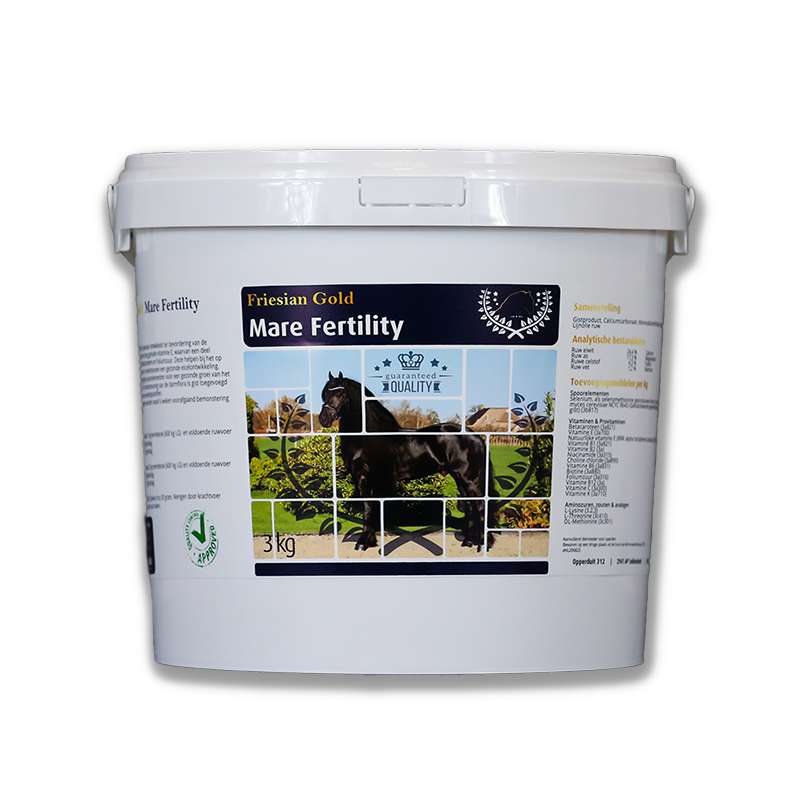
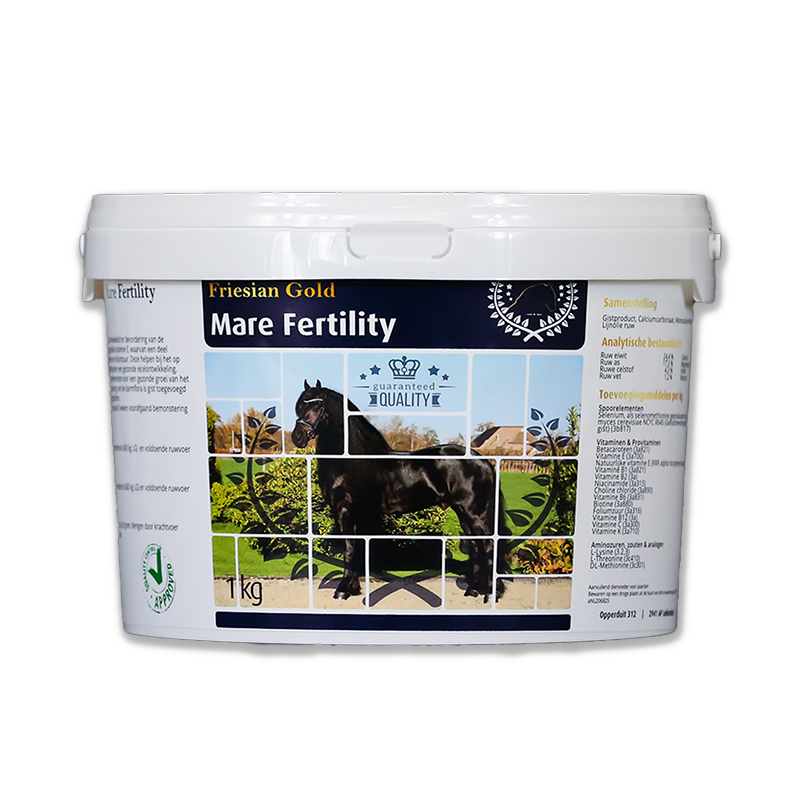
To give nature a helping hand, you can supplement Friesian Gold Mare Fertility. In fact, this supplement is specially designed to promote fertility. Vitamin E and Selenium are two well-known elements to support fertility. Vitamin E is a powerful antioxidant and, in conjunction with Selenium, protects body cells from free radicals. Friesian Gold Mare Fertility contains a high content of vitamin E, part of which is natural vitamin E, which is easily absorbable. Not only Vitamin E and Selenium are important, but also Beta-Carotene and Folic Acid. Low levels of beta-carotene can cause horses to show poorer stallions and have irregular cycles. Folic acid is known to promote proper development of the foal's nervous system. Folium contributes to healthy tissue growth in the mare during pregnancy.
To support the mare during pregnancy, Friesian Gold Mare Fertility contains important minerals and trace elements for healthy growth of the foal.
The supplement can be given from 6 weeks prior sampling and during gestation.
Cylcus Friesian and warmblood horses
It is not natural for a mare to become pregnant. In addition, the cycle of a Friesian mare is different from that of a warmblood horse. Indeed, the cycle of a Friesian mare takes longer because follicle growth is slower and before ovulation is greater than in warmbloods. Below is an overview of the main differences in the reproductive cycle. Thus, to maximize the chances of conception, it is important to recognize these differences.
| Warmblood | Fries | |
| Duration of cycle | 22 days | 24.5 days |
| Follicle growth per 48 hours | 3 mm | 2.4 mm |
| Diameter of follicle 24 hours before ovulation | 40 mm | 50 mm |
| Edema most present | 2/3 days before ovulation | 6 days before ovulation |
| hCG administration possible if diameter follicle is | >35 mm | >45 mm |
The correct insemination timing is very important. The mare should be inseminated 0-48 hours before ovulation to be sure of possible fertilization. Imminent ovulation is to be expected if the mare shows very stallion-like tone at scalping and sensing. On palpation, a soft follicle, a flaccid uterus and cervix should be palpable. An ultrasound may demonstrate a follicle of >45 mm. This is then the time for insemination.